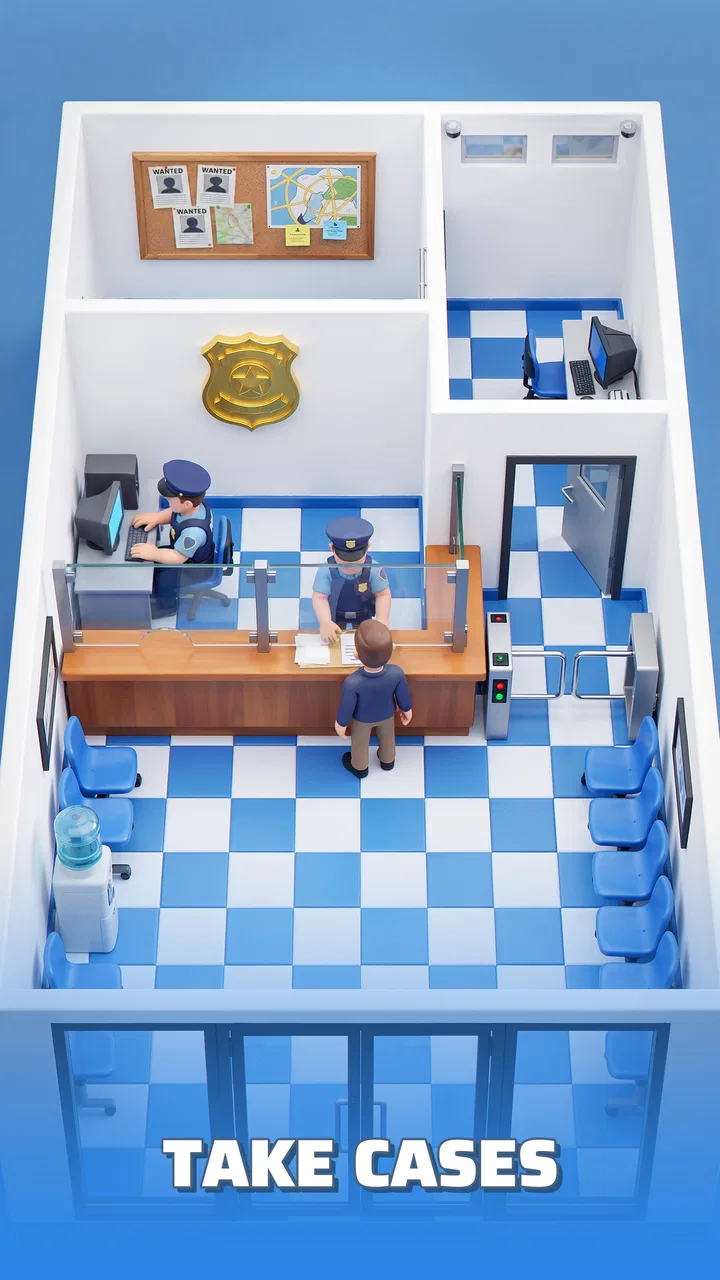
Police Chief
- 4.7
- Rating
- 1.00M
- Installs
- Free
- Price

 Analysis by App-foxy
Managing a police station sounds simple until every decision starts competing with another. Police Chief puts that pressure at the center of a strategy game built around the question of whether I can turn a busy station into an effective operation. I approached it less like a quick arcade distraction and more like a management challenge: the appeal comes from deciding what deserves attention first, then living with the consequences of those choices.
The premise is immediately understandable. I am not playing as a patrol officer in a traditional action game; I am stepping into the broader responsibility of running a station and working toward recognition as a respected police chief. That gives the game a different rhythm from crime shooters, tactical battles, or city-building games. Its strongest idea is the shift in perspective: success depends on managing an organization rather than simply winning individual encounters.
VoyagerOne IE is the developer behind this free strategy game. It is aimed at a Teen audience, so I would not treat it as a young-child title simply because the basic premise is easy to understand. The game has also attracted a 4.7 average from around 18 thousand ratings and has passed 500 thousand installs, which suggests that the management concept has found a substantial audience.
You May Also Like

 Blood Strike: 2.5 Anniversary
Blood Strike’s Loadouts Turn Every Drop Into a Tactical Gamble
A close look at Blood Strike’s custom loadouts: how fast access to signature weapons reshapes its battle royale rhythm, rewards preparation, and narrows the gap between fights.

 Pandora - Music & Podcasts
Pandora’s Music Is Easy to Start, but Harder to Recover
Pandora’s strength is its low-effort path from a seed to a station. Its weak spot is how much confidence it asks you to place in connection, setup, and quiet recovery.

 8 Ball Pool
 Is Built on Rivalries, Rematches, and Routine
A close look at the rivalries, rematches, shared routines, and unanswered safety questions that turn a quick pool match into a persistent mobile community.

 Samsung Music
’s Quiet Strength Is Playing What You Already Own
Its reach comes less from spectacle than from dependable access to a personal library. That simplicity is both the app’s strongest retention engine and its ceiling.

 AccuWeather: Weather Radar
AccuWeather Review: A Quick, Clear Forecast for Everyday Decisions
For everyday plans, the best forecast is the one you can understand quickly. AccuWeather makes rain timing, radar, and local conditions easy to act on, with a few trade-offs.

 Hill Climb Racing
Why Hill Climb Racing Still Turns Crashes Into One More Run
A tiny car, a bumpy hill and one more upgrade: Hill Climb Racing keeps resurfacing because its simple chaos makes every near-miss feel personal.
More From Our News Desk
View All News


How the management experience works in practice
What kept me interested was the constant need to think in priorities. A police station naturally creates several competing demands, and a good manager cannot treat every problem as equally urgent. I found myself asking whether to improve immediate performance, prepare for a later bottleneck, or save resources for a more important opportunity. That kind of decision-making is the real attraction here, rather than the surface fantasy of holding a prestigious job title.
The game works best when I play in short, deliberate sessions. I can check what needs attention, make a few adjustments, and leave with a clear sense of what I want to revisit next time. That makes it suitable for a commute, a break between tasks, or an evening when I want strategy without committing to a long uninterrupted campaign. It is less satisfying if I expect constant action, because the pleasure comes from planning and observing results.
A useful habit is to avoid spending everything as soon as a new option becomes available. In management games, an upgrade that looks attractive immediately can leave the station exposed when a more urgent need appears. I got better results by keeping a reserve and deciding what kind of problem I was preparing for. This is one of the more important lessons for new players: progress is not only about making the station stronger, but also about preserving flexibility.
Another practical approach is to use each session as a review of the station’s weakest link. Instead of improving whatever is most visible, I would look for the part of the operation causing the most delay or limiting the next step. That method makes progress feel more intentional and reduces the temptation to make random purchases. It also gives the game a satisfying analytical layer that is easy to miss if I rush through every prompt.
I also recommend separating “nice to have” improvements from changes that actually unlock better decisions. The distinction matters because management games often present several appealing directions at once. When I treated every improvement as equally valuable, the station felt scattered. When I chose a clear objective first, the same choices became easier to judge. This is a small change in play style, but it makes the experience feel much less confusing.
A realistic everyday session
Imagine opening the game during a ten-minute lunch break. I would first inspect the station, identify the most immediate restriction, and make one or two decisions rather than trying to reorganize everything. If a new task or opportunity appears, I would consider whether it supports the current plan or simply looks exciting. Then I would close the game with a short-term target in mind, such as preparing for the next improvement instead of spending impulsively.
That routine suits Police Chief better than trying to marathon it while multitasking. The game benefits from attention because the important question is not just “what can I do now?” but “what will this choice make easier or harder later?” A player who enjoys checking progress several times throughout the day may find that rhythm rewarding. Someone looking for a complete story in one sitting may find it slower than expected.
Free access and the real value question
The game is free to download and play, so the initial decision is straightforward: I can try the central management experience without paying an entry fee. That is meaningful value for anyone unsure whether station management is a good fit. I would install it, learn the basic rhythm, and decide based on the actual feel of its decisions rather than committing money before understanding the loop.
There are optional in-app purchases ranging from $0.99 to $99.99 per item. That wide range makes spending discipline important. The free entry point is useful, but it does not mean every possible convenience or progression choice is free. I would recommend treating purchases as optional support for a game I already enjoy, not as part of the basic installation decision.
The most sensible value test is simple: can I enjoy planning the station without feeling pressured to accelerate? If the answer is yes, the free access has a strong advantage. If I only enjoy the game when progress moves faster, the purchase range becomes more relevant, and I would be more cautious. A large optional purchase is difficult to justify before I know whether the management loop will hold my attention for more than a few sessions.
I would also avoid judging the game by the biggest available purchase. The useful comparison is between the free experience I can actually play and the specific convenience I might want later. That keeps the cost question grounded. For me, the game earns its place on a phone if the basic decisions remain enjoyable without spending; purchases should not be the reason I install it.
Where it differs from familiar strategy alternatives
Compared with a conventional city builder, Police Chief narrows the focus to one organization instead of asking me to design an entire urban landscape. That smaller scope can make decisions easier to understand and more personal. I am not balancing every municipal service at once; I am concentrating on the responsibilities of a police station and the path toward becoming a recognized chief.
Compared with a tactical strategy game, it is less about controlling units during a single confrontation and more about maintaining an operation over time. Players who want precise turn-by-turn combat may prefer a tactical title. Police Chief is a better match for someone who enjoys prioritization, gradual improvement, and the feeling that a series of ordinary administrative choices can shape the station’s future.
It also differs from an idle management game in the way I engage with it. Idle games can be satisfying when I mainly collect progress and return later. Here, the premise encourages me to think about why I am making a decision and what kind of chief I am trying to become. If I want a completely hands-off experience, this may feel too demanding. If I want more agency than simply claiming accumulated rewards, the strategy framing is a benefit.
The trade-offs that matter before installing
The narrow theme is both the game’s identity and its main limitation. If the idea of managing a police station does not interest me, there is not much else to disguise that fact. The game does not appeal to every strategy player in the same way a broad empire builder might. Its value depends heavily on whether organizational management feels engaging rather than merely administrative.
The pace can also require patience. A station does not become world-renowned through one clever move, and the game’s appeal is tied to gradual progress. I would not choose it when I want immediate spectacle or constant action. The better mindset is to enjoy small improvements, review decisions, and accept that some progress may require waiting or returning later.
There is a second trade-off around spending. Free access lowers the risk of trying the game, but the presence of purchases up to $99.99 per item means I would keep a firm budget if I decided to buy anything. I would never make a purchase simply because a timer, obstacle, or moment of impatience made it tempting. The game is easiest to recommend when players are comfortable enjoying the free route and making deliberate choices about optional spending.
The Teen content rating is another reason I would think about the intended audience. The premise involves police work and public safety, so parents should consider whether that theme suits a younger player rather than assuming the management format makes it automatically child-friendly. Teen players and adults interested in the subject are more likely to appreciate the tone and responsibility suggested by the role.
Small strategies that improve the experience
My first tip is to set a session objective before making changes. “Improve the station” is too vague; a more useful goal is to remove one bottleneck or prepare for one upcoming step. This prevents scattered spending and gives each short visit a purpose. It also makes it easier to tell whether a decision helped, because I am measuring it against a clear intention.
My second tip is to keep a mental reserve rather than converting every available resource immediately. The reserve is valuable because it protects me from being forced into a poor choice when the station presents a new demand. This is especially useful for players who open the game frequently but only have a few minutes. A cautious manager can make steadier progress than an impulsive one, even when both have similar opportunities.
My third tip is to judge upgrades by opportunity cost. Ask what I am giving up by choosing one improvement now. A more visible improvement may feel satisfying, but a less glamorous change could open better options later. This way of thinking is more advanced than simply selecting the most expensive or newest option, and it is where the strategy becomes more rewarding.
Finally, I would use the version number as a practical installation detail: the current version is 0.0.763, and the minimum operating system requirement is Android 5.1. That makes the game accessible to many older Android devices, although a compatible system alone does not guarantee that every phone will feel equally comfortable during longer sessions. I would still keep expectations realistic if my device is dated or storage is limited.
Who will get the most from it?
Police Chief is a good fit for players who like management games with a clear professional role. If I enjoy deciding what deserves attention, weighing short-term convenience against longer-term progress, and checking a developing operation over several sessions, the premise has genuine appeal. It is also a reasonable choice for someone who wants a strategy game that feels more focused than a full city simulation.
It can work well for casual players because the free entry point makes experimentation easy. I do not need to know whether I will become a dedicated fan before trying it. The strongest audience, in my view, is someone who wants a game for repeated short visits but still wants decisions to matter. That combination gives the station-management theme room to breathe.
I would skip it if my priority is real-time action, competitive multiplayer, elaborate tactical battles, or a narrative adventure led by memorable characters. I would also skip it if I dislike games where progress is gradual and optional purchases require careful self-control. A traditional action game would be a better choice for immediate excitement, while a deep city builder would be better for players who want a much wider planning canvas.
Players who are especially sensitive to monetization should begin with a strict personal rule: play for a while before buying anything, and never spend to solve a moment of frustration. That approach keeps the free aspect meaningful and makes any later purchase a considered decision. The game is not the right fit for someone who wants a completely purchase-free environment without having to think about optional offers.
My verdict on the free strategy experience
I came away seeing Police Chief as a focused management game rather than a police-themed action title. Its best quality is the way it turns the broad fantasy of becoming a respected chief into a sequence of practical priorities. The station gives the strategy a clear identity, and the free entry point lets curious players test that identity without paying first.
The trade-off is that the experience asks for patience and restraint. Its narrower subject will not satisfy everyone, and the in-app purchase range means I would approach spending carefully. Still, players who enjoy gradual organizational progress can find solid value in the free version, especially when they use reserves, set session goals, and judge choices by their long-term effect.
My recommendation is to try it if the idea of running a police station genuinely interests you and you prefer thoughtful management over constant action. I would skip it for a pure combat experience or a broad city-building sandbox. For the right player, the strongest value is in learning to manage pressure without rushing into purchases; that is where this strategy game feels most distinctive and most worth returning to.
FAQs for Police Chief
01What is the main objective of Police Chief?
Police Chief is a strategic simulation game where players assume the role of a police chief tasked with managing law enforcement operations in a bustling city. The main objective is to maintain order, solve crimes, and ensure public safety by effectively deploying resources and making critical decisions.
02Are there in-app purchases in Police Chief?
Yes, Police Chief includes in-app purchases that allow players to buy additional resources, such as coins or special items, to enhance their gaming experience. While the game can be enjoyed without spending money, these purchases can accelerate progress and unlock exclusive content.
03Is Police Chief suitable for children?
Police Chief is generally suitable for older children and teenagers due to its strategic elements and crime-solving themes. However, parents should be aware of the game's content, which includes scenarios involving crime and law enforcement, and decide if it aligns with their family values and the child’s maturity level.
04Does Police Chief require an internet connection?
Police Chief requires an internet connection for certain features, such as accessing leaderboards, completing online missions, or receiving updates. However, some aspects of the game may be playable offline. For the best experience, a stable internet connection is recommended.
05What platforms is Police Chief available on?
Police Chief is available for download on both Android and iOS platforms. It can be found on the Google Play Store for Android devices and the Apple App Store for iOS devices, ensuring a wide range of compatibility for various smartphones and tablets.
Pros
- Intuitive interface simplifies navigation.
- Realistic scenarios enhance gameplay.
- Diverse missions keep engagement high.
- Customizable characters add personal touch.
- Offline mode available for uninterrupted play.
Cons
- In-app purchases can be costly.
- Limited language options available.
- Occasional lag on older devices.
- Ads can disrupt gameplay experience.
- Large file size may require storage space.

Police Chief
Gallery